
 Posts


Ah February, the shortest and often the coldest month of the year. I
love February for the skiing, for rib-sticking hot food and wearing tall
boots with my skirts and dresses. Sitting with my kids while I enjoy a
mocha drink and them their hot chocolates is a perfect activity during
this cold winter month.
This is also the month that advertisers
suddenly are reminded that they have a heart and want to share it with
you. The ads will be heart-warming; the colors of red and pink will be
seen everywhere and the words love, forever, roses, diamonds and
chocolates will weave a haze of happiness so thick, you may be glad to
see the end of the month. It is not that I don't enjoy Valentines, but
sometimes it takes on a quality of consumerism that feels tacky.
I have done some light reading as to why chocolates, diamonds and the rest are ubiquitous to February 14th, or Valentines Day,
often causing much surprise and heart ache each and every year in every
culture that celebrates it. The answer seems to be lost in myth but
the idea of giving a gift or poem appears to be one of shrewd
marketing. At first this seems a bit depressing, at least to me, when
you suddenly discover that you are but a lemming by nature and following
the whims of a good marketer, but think again. How many ideas exist
that become annual celebrations, that inspire people to reach out and
take a risk giving away chocolates, diamonds and the red heart shaped
cards on one day a year? Not many. Will we see the iPad seven centuries
from today? It is highly unlikely. And how many of us celebrate
Grandparents day? Yes, there is a day for that, and I love my
grandparents but I have never celebrated this day. Have you? After all,
we celebrate Valentines Day which includes every family member you can
find.
So it was a brilliant marketing idea. It was created on our own
need to share for one day out of the year, your feelings for someone
else. So upon reflection, Valentines Day and celebrations like it ( for
some reason I can only think of the Super Bowl as an example) share
this desire to connect that is well outside of the marketing hype.
Valentines Day, in spite of its over-the-top commercialism, is a day
created by you and me.
So treat yourself and others too, to
chocolates, or wine in paper cups on a bench overlooking the ocean, or a
diamond for yourself, because you have to show yourself the love too.
Happy Valentines Day.
Monday, February 13, 2012


Wednesday, January 4, 2012
Happy New Year to all,
And welcome to 2012. Since 2007, my life and those connected to me
have endured loss, even heartbreaking loss, celebrated joys, and discovered that
life takes on a crooked path. There were times when, upon awaking, that I
wanted everything to be different, and there were times when I went to sleep
glad to have seen the day.
This year may or may not bring prosperity to those who find themselves in dire straits; it may or may not bring about great changes in politics or global anything. Someone will wake up to do harm, another will arise to save a life, and another just manage to survive; and, upon and within that crooked path I am on, I will probably be on a first name basis with at least one or all of these people.
I am resolute that this year I will make every effort to wake up and hold love close to my heart. I believe this step will help me in 2012. It will remind me to help those who are in need, knowing that paths take on trouble and strife in all walks of life; it will be that one thing which will keep me strong in my faith of a higher power, the worth of my family and the worth of all human beings; it may keep me sane when I feel as if I am talking on a different radio frequency than everyone else. When I succeed in doing this and can hold love in my heart, I will see my children burn with a brighter energy and people around me respond with more ease and lightness. I will be more able to deal with the crooked path of life and more capable of forgiving myself of my own stupidity.
Luckily for me, I have more chocolate tiles to make and create. Holding love close to my heart while I create something that gives a moment of happiness to others, well, I am sure that this resolution may be the secret ingredient to all good things in life (oops, I guess that is like giving away a trade secret if it makes my chocolate taste delicious). So, from my house to yours, I give you my trade secret for 2012.
Monday, November 28, 2011
It
has been awhile since I have had time to write a post. With my
family's busy summer and the new transitions for my children with
school, the days have flown past me and now suddenly we are in December.
One
important event for me was getting my first, and hopefully last,
crown. The hardest part was receiving the injection to numb my entire
mouth; the shot was very painful,
even with my dentist's careful ministrations. When the numbness went away a few
hours later, I was left with a curious sensation on the surface of my
tongue and alarmingly, the lack of taste. The sensation died down but
did not entirely subside and my taste buds seemed traumatized. I
assumed it would be fine with time and forgot to mention it to my
dentist when he went in to numb me
again to fit the crown. This time, when the numbness subsided, I
noticed the same curious sensation similar to eating a "hot" candy or eating a
jalapeno; a burning that seemed to swell each taste bud and that seemed
to move across and under the front area of my tongue. And at that
moment in time, I could not taste anything at all.
I
did and do find this alarming. Luckily, I am an experienced cook and
can add ingredients based on years and years of cooking with ratios. All
of my chocolate blends are
written down which means that I all I have to do is follow a
recipe, my own; however, during the conching process, I taste the chocolate
after 24 hours on a timeline which includes a period of time that I must conduct a taste test as often as every thirty
minutes until I feel that the balance of chocolate flavors feel right to
me; a process that can take up to three days. Not being able to taste, in a balanced way, has stopped me from
making chocolate for a few months now. As time has passed, my ability to taste has returned, slowly and with a curious unevenness i.e.
for about a month I was deeply aware of sugar. Any sugar in a food or
drink product registered on my taste buds as sickeningly sweet. I
almost could not eat, the sweet
flavor was so strong. I was able to eat bitter chocolate and even then
was aware of a sweetness that was almost unbearable and the awareness of
sweetness would last for hours.
Which, of course, leads
me to think about flavors in chocolate, the balancing of flavors in
chocolate and how important it is to remember that at any given time, a
person may experience flavor that disappoints during one taste test and
then, taste it again, months or days later and find that they LOVE it. I
can taste again, and for this I am extremely thankful, and will be
getting back to doing what I so enjoy doing, making chocolate, eating
chocolate, and sharing chocolate.
May your holidays be filled with a sense of hope, joy and chocolate
Tuesday, June 21, 2011
Home from Paris.
I have returned home from a seven day vacation in Paris, France, relaxed and feeling rejuvenated. I enjoy New York City, its never-ending wakefulness, a city that is always looking at itself in a mirror and a city, that for me, boredom does not exist. I enjoy Copenhagen for its modern flair of art and light, how often the people laugh; and I love Sweden for the walking paths that connect the entire country; but it is time spent in Paris that I arrive back to my home rejuvenated, rested in body and soul, coming home ready to begin my real life and bringing some of my experience of Paris back home.
Paris is designed to stroll through its avenues and parks, causing tourists to slow down often without consciousness. Comparing the noise level in New York City to Paris, shows Paris to be a remarkably quiet city. It is not quite like the cities in Denmark and Sweden. No, these cities do not have the sheer number of tourists. It is in Paris that the French people speak in normal tones in the parks or restaurants or the Metro, making one aware of your own voice and even the tourists drop into normal tones during their stay.
Alexis de Belloy recently wrote an article for CNN about vacationing in France and he hit upon something that really struck me as important. He wrote that vacationing was meant to be a chance to experience luxury, not of spending money but of spending time to do the things he would do if he had the money, and to do them every day. That is precisely what I do in Paris.
On a beautiful spring day, I enjoyed eating at an outdoor cafe for over two hours in the Tulleries Garden while gazing at the art nearby, art that is juxtaposed next to each other from ancient to modern, at the people walking by and people sitting in lounge chairs soaking up the sun in cool weather. I enjoyed my rather gruff waiter, clearly frustrated with me for speaking English, his frustration with other patrons who do not understand why he has not given them their check, his frustration for having to explain again “what is that anyway”.
I am not in any hurry to leave or get my check or have him explain the menu. I had purchased some chocolate earlier to eat as my dessert and my gruff waiter ends up giving me a terse smile (this is a win if you have ever eaten in a French restaurant with a male French waiter) as he sees the name of the chocolatier on the bag and the chocolate tile in my hand. I know that taste and memory is affected by one’s surroundings, and that first bite into that piece is the high notes of cherries that give the bright clear spring skies a sharpened crispness, promising a beautiful summer; the cool melt of the cocoa butter like the light wind of spring cooling the skin from the sunny day, and the decidedly chocolate low note that suddenly becomes the perfect end to a lovely meal in an outstanding Paris garden. Yes, I come home from Paris with the best souvenir. I have tasted the life of luxury for seven days and will again.
Tuesday, May 3, 2011
Seattle, Washington gets chocolate!
If you live in or nearby Seattle, plan on attending the Seattle Chocolate Salon on May 14th. I believe there are 100 tickets - maybe less by now - for this event.
Click or copy and paste into your browser the link below.
http://www.seattlechocolatesalon.com/
Eating chocolate for three or fours hours is an amazing experience for someone who loves to taste chocolate. Be sure to drink sips of water throughout your stay, taking breaks to clear your palate and eating a protein rich breakfast to avoid feeling queasy later that day. Mostly, have fun and share the experience with someone.
Sunday, April 17, 2011
Disclaimer.
I'm just a mom and wife, who happens to make chocolate from the bean, and used to make a living cooking in commercial kitchens. Of all the things I am, what I am not is an editor.
I take, or more correctly, create time to do those things I love or absolutely need to do. Writing is slowly becoming more and more enjoyable and the process is, surprisingly, deeply satisfying; however, editing ends my creative process. With limited time to do things that are not creative, I will reread my posts about three times. When I am really pushing myself, I will read the post out loud, finding the silly errors like shutter instead of shudder and not finding it later after it has been posted. (I did make a comment on this particular mistake, but it doesn't always appear when I check my blog)
With eBlogger, making changes after the post is published means that you, the reader, get notifications that I have posted something new. I find this bothersome, as if I am calling and hanging up the phone just as you answer it. My solution is that once a month or so, I will be sending a notification that I am making corrections and to ignore the next notifications you receive that day. It will be similar as the bank or credit card notifications we receive, that all of your information may be compromised, and they are working on it, but mine will not have the consequences as those.
Now, make the world a better place and eat some chocolate. ;-)
Friday, April 8, 2011
Fats, lipids and oils.
I love to cook with fats and oils. I love the tastes and smells it imparts to foods. I like using an avocado with its high fat content to create a creamy dressing that is both healthy and satisfying, or using peanut oil which adds a wonderful flavor to quickly cooked foods. Walnut oil is intense and a little goes a long way in dressings or drizzled over something warm. The addition of lard or suet - if you can find it - in pound cakes is marvelous; wrapping lard or suet around a piece of meat is to rediscover an age old method to keeping meat tender and moist with the added flavor making it sumptuous.
As a cook, one must learn the properties of fats and oils to decide what will work best in a recipe, whether sweet or savory. Cocoa fat, combined with the protein in the cocoa bean, is what thickens the warm or hot drink enjoyed centuries ago and, when done correctly, creates a velvety texture. The method of creating cocoa powder that is used in today's hot chocolate requires that most of the cocoa fat is removed, thereby removing the velvety texture and yet allowing for rapid dispersion in cold milk or water. In today's world, we are rediscovering the texture that was once created by beating the chocolate fat into an emulsion using methods that did not exist years ago, a method that could take over an hour. Today we re-create that amazing texture with different methods that don't require a strong arm and loads of free time.
Cooking with the fat in cocoa beans for savory cooking is a wonderful adventure, an excellent way to learn how flavor builds upon other flavors. As a cook and as someone who enjoys great flavors, exploring the savory side of chocolate is a entirely new way to understand how the fat in cocoa is special compared to other fats -- for me that is a key to happiness.
Tuesday, April 5, 2011
Calling all chocolate lovers in the San Francisco Bay Area.
A reminder to everyone, that if you are planning to attend this wonderful chocolate event, you must purchase your tickets by April 16th, 2011. Truly, this is a chance to taste and eat as much chocolate as you desire without feeling guilty about it.
http://www.luxurychocolatesalon.com/
http://www.luxurychocolatesalon.com/
Monday, March 21, 2011
Today I have a link.
I think this is a thoughtful article about why it is important, from a business standpoint, to work and teach farmers sustainable farming practices. Take a moment to read it when you can spare the time.
http://online.wsj.com/article/SB10001424052748704608504576208123457763158.html?mod=dist_smartbrief
http://online.wsj.com/article/SB10001424052748704608504576208123457763158.html?mod=dist_smartbrief
Tuesday, March 15, 2011
Bravo to Hershey!
Next weekend I will be throwing a birthday party for my youngest daughter. Instead of cake, she wants to have s'mores; that wonderful and messy campfire dessert with graham crackers, marshmallows and a small or large portion of chocolate combined with fun and googyness make for a great memory treat.
I will not be using the chocolate I create as it is expensive and her little friends would not appreciate the flavors I work so hard to create. I will be using Hershey's milk chocolate bars another comfort chocolate of my youth. To use my chocolate would be like using a handful of Himalayan sea salt to flavor pasta water when regular salt would be best. I shutter at the thought. For me, every chocolate created has a place at my table, depending on who my guests will be and what I am serving.
Why would I mention this? Well, I have learned that Hershey has funded a study that supports my post on the reduction of flavanols in cocoa beans when submitted to heat. Hershey's honesty and integrity make me proud to purchase their product. Many of the large chocolate companies are currently researching the health benefits of chocolate and they have been funding these studies for a long time. To have a health benefit while eating a much loved candy can only improve the bottom line. The study doesn't take away what appears to be a small cardiovascular benefit from eating dark chocolate; it calls into question what does it mean to have a raw cocoa bean. I have eaten a raw cocoa bean. I have yet to see or eat a truly raw cocoa bean in California.
I am trying to attach a link via the article to eBlogger but the link will not work. I will try to get a working link soon. Below is a copy and paste paragraph of the article in Confectionery News by Jane Byrne.
"The authors reported that in terms of the epi/cat ratio, the highest were found in unripe and ripe, unfermented dried beans. Fermentation and roasting lowered the epi/cat ratio further, with the lowest ratios found in Dutch-processed cocoa powders." Source: The Journal of Agriculture and Food Chemistry
DOI:10.1021/jf102391q
Title: Impact of Fermentation, Drying, Roasting, and Dutch Processing on Epicatechin and Catechin Content of Cacao Beans and Cocoa Ingredients
Authors: M.J Payne, W. J. Hurst, K. B. Miller, C. Rank, D. A. Stuart
Monday, March 7, 2011
Rising prices of cocoa beans, sugar and cocoa butter.
Our US newspapers in December 2010 and January 2011 were filled with bold headlines that the price of cocoa was going up. A few people asked me with deep concern what was going to happen, how much more expensive was their favorite chocolate going to become, and if I thought a shortage of chocolate would be coming to the US soon. I don't know. As a micro business, the costs to run it vary greatly as a matter of course and I can only watch and wait for the future to unfold. I will venture a guess that prices will rise and fall and then rise again as instability in the Ivory Coast continue.
The Ivory Coast provides a huge percentage of cocoa products to the western world and cocoa beans play an important role in the current call that the EU support a sanction of this product. The hoped for result is that this will stop the large amount of monies flowing into the country that pay the civil servants, encompassing the military, police and other government employees. If the civil servants don't get paid, maybe one man will stop being president and another will take his place. Of course, this is an over-simplified view.
The middlemen, who include farmers, exporters and others, burned bags of cocoa beans in protest of the sanctions. They have families to feed and the sanctions make this virtually impossible. Commerce is tied to politics and fear of lack is a huge motivator in future prices and when banks stop working money stops flowing.
I do not believe that the large cocoa conglomerates are going to go bankrupt any time soon. They will use cash instead of banks to do their business and the ties to this country are long. But the farmers and small businesses will bear a greater proportional brunt of price volatility on both sides of globe and consumers must decide how much it is worth to them.
And don’t get me started on the price of oil.
Monday, February 28, 2011
The closing of Cosetinos in San Jose, Ca.
I have recently learned that Cosentino's in San Jose, CA. closed on Saturday, February 27, 2011. This store is near and dear to my heart, as this is where I discovered 'real' chocolate. Previous to the summer of 1970, my experience with chocolate was limited to Hershey's milk chocolate bars and M&M's. We had recently moved into the area and Cosentino's was a mile away, walking distance, from my house. The first time we shopped at this store, I experienced an awakening of my culinary senses. Here there were barrels filled with pickles, a real butcher shop, a cheese counter, a bakery of wonderful goods (oh, my aching sweet tooth), and vegetables I had never seen before in my life. The aromas from this store were both tantalizing and confusing as many of those aromas I was unable to identify at that time.
My favorite was the chocolate aisle. Along one end of this aisle lay before my eyes a mass of chocolate candies from different countries and I remember taking my allowance and purchasing the dark chocolate that cost me the entire allowance. That first taste is, to this day, an experience that shaped my opinion of what chocolate should taste like. I spent my entire weekly allowance on different chocolates at this store, carefully dividing it into seven days, long enough to last until my next purchase. Every week without fail I walked to this store and purchased my treasure, except of course when I lost my allowance due to some negligence my parents felt was inexcusable. Those were long weeks. To this day I am closet chocolate eater and now a chocolate maker. Thank you Cosetino's.
I am sad over this closing. It was a wonderful store. I shall miss it.
Wednesday, February 23, 2011
Growing cacao tress.
Cacao's history, so far, originates from Central and South America. Cacao trees are rather picky about where they grow. Left to their own biological devices, it is possible that they would have grown close to their origins and not much farther, since the tree is reliant on animals to open the pods, eat and disperse
But back on my topic. When you look at a globe, you can imagine a belt centered on the equator to understand where cacao trees grow best. After subtracting all the water and areas that are too high in elevation or too dry or too far from water, and suddenly you have a limited area where we can get cocoa beans. Costa Rica is able to grow the cacao tree, especially under the canopy of the jungle, giving rise, literally, to the millions of small midges that pollinate the flowers. But it isn't a perfect environment in Costa Rica for the trees, so it is always a challenge to get a high crop yield from the farmers’ efforts.
So with care, cacao trees can be planted in places that are humid, without which the seed would not thrive, year round water, and enough shade and heat to allow quick decay of vegetation, giving rise to the tiny insects who give life to many plants and animals, and made my life a bit miserable by their sheer numbers.
Thursday, December 9, 2010
What does raw cocoa mean?
I recently was in a discussion with someone about the benefits of raw cocoa beans. She produced a bag of nibs and asked me to taste it. The first thing I noticed was the smell of an acidic quality signaling poor processing; the second was that the nibs were not a light white or purple but a light brown coloring. They also had a chocolate flavor, not great and they were bitter, but the chocolate flavor was there. Having eaten cacao beans straight from the pod, I knew these were not raw, and hence the confusion for people who are taken in by companies claiming to have raw beans or paste.
Raw beans are astringent. They are very astringent. There is no chocolate flavor and the saliva is ripped out of your mouth, leaving it dry and uncomfortable. Some people may experience this astringency more or less than myself, but it is different from the bitter quality that happens after it has been fermented.
Fermentation is a process of heat, and heat destroys pathogens and much of the antioxidants in any raw product. Fermentation also creates the chocolate flavor we recognize and enjoy. (I remember when Odwalla used to sell unpasteurized apple juice claiming that raw was better for you. Unfortunately, a few people ended up dying from salmonella poisoning from drinking their raw apple juice. Odwalla is lucky to still be in business, but then again, they no longer sell raw apple juice.) Cacao beans start fermenting almost immediately after being picked off the tree, creating an environment that begins the degradation of the bacteria, pathogens and antioxidants of the raw bean. The same antioxidants that so many people believe will ward off cancer, aging and even delay death. I won't challenge the ideas of the healing power of antioxidants, but I will challenge the marketing of "raw beans". Even a little heat changes a product from raw to not raw. Parboiling before canning is a good example of eliminating those pesky bacterias that can make a person seriously ill but the parboiling process also begins killing the more fragile and desirable mineral and vitamins. Even a little fermentation of the cacao bean, under 111 degrees Fahrenheit, starts changing the beans taste and level of antioxidants available for people to benefit from when they ingest the cocoa. I believe that unless a cacao company is putting all their pods into a refrigerated container immediately after the pod is removed from the tree and keep it under controlled cool settings all the way to the grocery shelf, that they can not, and should not, call it raw. The expensive of doing this would make it nearly impossible for most small farmers who grow cacao trees to create this product. I am not saying there isn't a company who is doing it with this much intergrity; I am only saying I highly doubt it and have yet to find a company who does this.
Personally, I would enjoy chocolate in nib or candy form, for its taste and leave it to your local farmer for the fruits and vegetables that you can purchase in your city for the health benefits of antioxidants.
Monday, November 8, 2010
A signature.
Today is a perfect day to make chocolate and that is what I just finished doing, the completion of chocolate tiles, cooling and getting ready for the next step of wrapping.
As I contend with many different factors while creating these chocolate tiles, I am aware that I have a signature in my chocolate. Painters and weavers, carpenters and architects, and all those who create for a living, have a signature. I recently read of a newly found painting assumed to be painted by Leonardo da Vinci's very hand, without his pupils, now under scrutiny by those who know his signature, to prove or disprove the paintings creator. My chocolate flavor profile and the tiles themselves have my signature stamped all over them. For the record, I make no claim of being a master painter or even a master chocolate maker. I still have much to learn.
I make my chocolate by hand, and the imperfections tend to be repeatable. In fact, I am not sure that I can make something completely perfect, like a machine can, and, if one day I hire someone to do some of this process of chocolate making, how that will affect my signature and is this good or bad? I do try new methods and, even as I explore a new way of creating the tiles, I make certain style decisions that identify me as the maker.
In the end, I have product that does not last long, as does a da Vinci painting, so my signature is fleeting, but a brief moment of recognition is worth all the work I put into making chocolate.
Monday, September 13, 2010
While eating a piece of chocolate...
 |
| Another thank you to Becky Sands for the pictures. |
Then one must pick the fruits of one's labor. The men who work at Finmac were very patient with us, giving us the opportunity to experience the skillful work of cutting off the pods, from the middle and upper parts of the tree, using the knives attached to long poles. It was tricky to cut the pod without damage to the limb, allow it to drop to the ground, and then pierce it with the small curved knife on the reverse side of the long pod cutting tool. We all attempted to gracefully transport the pod through the air into the very large backpack and, once the backpack was full, tip all of the pods into the bucket.


Monday, August 30, 2010
Something to note,
 the next time I travel to a country that grows cacao, I will pay attention to where the equator lies in relation to the country I am visiting, since this effects the triglycerides in the bean itself. This is important to know since it is the fats, the triglycerides, that determine how hard the chocolate will be when tempered and gives the chocolatier a better idea of the highest and lowest heat ranges needed to create their best product. Knowing this little piece of knowledge would have helped me tremendously as I began making chocolate with the beans I had brought back from Finmac, and saved me a lot of time and trouble and a few choice words, that are best left unwritten. Once I did my homework and learned that Costa Rica is very close to the equator (all of three minutes), I was able to adjust my recipes and create some lovely chocolate. Viva Costa Rica! Pura Vida Costa Rica.
(A big thank you to Becky Sands who provided me with this picture. As always, all words. pictures and content may not be used unless you have permission from me)
Tuesday, June 29, 2010
Watching plants grow.
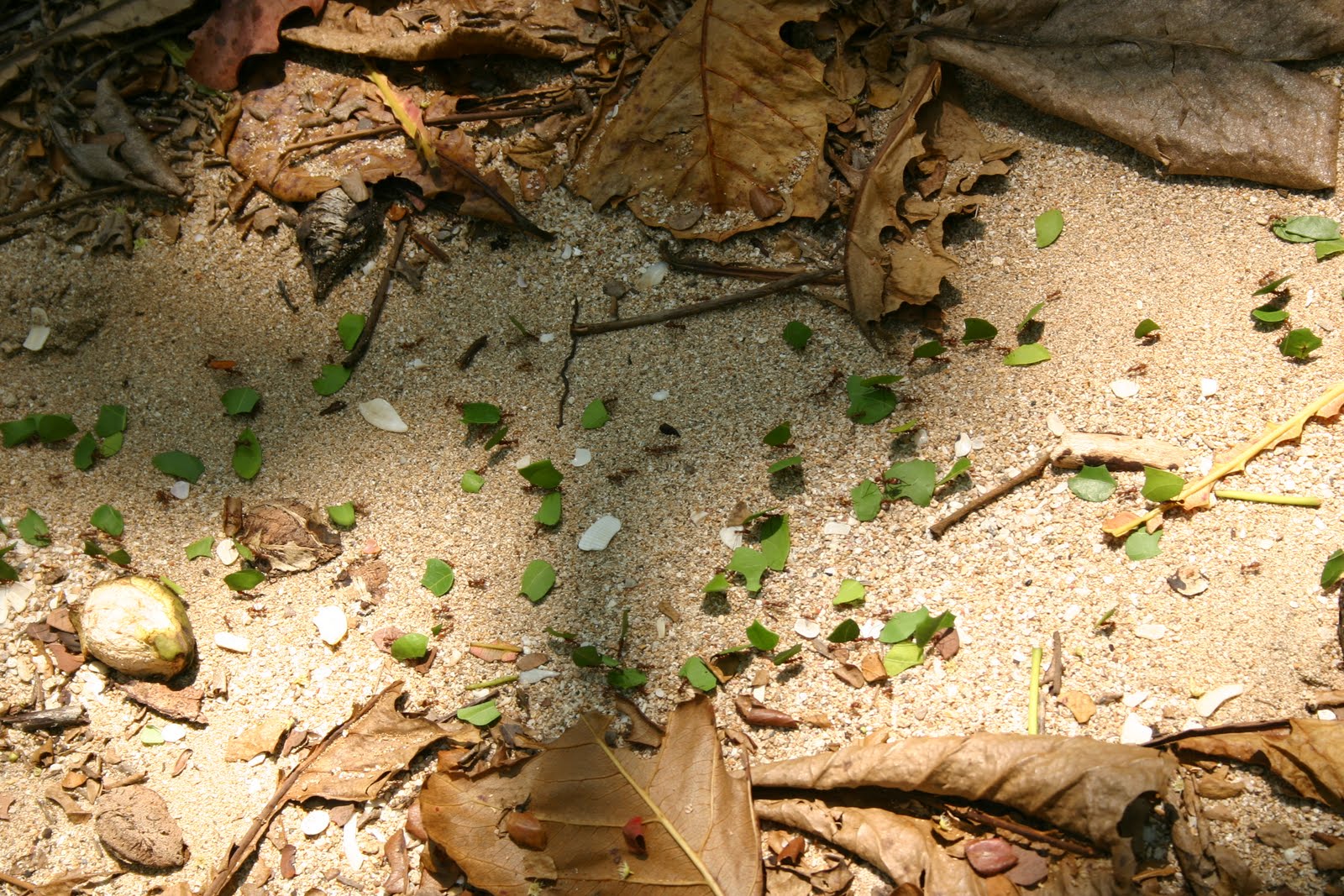 The jungle grows quickly, and the life and death cycle makes for a lot of debris on the jungle floor. Leaf Cutter ants were abundant and you could see them carrying large pieces of leaves or flowers, some of which were removed directly from the tree and plants around us, taking them to wherever their home lay. Where there is death, rot and decay, there is also life. An abundant amount of life. I saw more butterflies in Costa Rica than during my entire life to date, including a large blue butterfly that seemed to follow us throughout a nature walk; chattering monkeys, one who, at first, looked as if he were smiling but, we learned, was demonstrating a sign of aggression; we noted the tourists he chased down the path, all running at a very fast pace. The birds of prey and birds of a less aggressive nature came together in a large cloud of wings, catching the heat and circling, soaring so high that they were dots in the sky; way too many dogs (many running in packs and clearly hungry) and bugs. The big bugs, while scary looking, were not that difficult for me to deal with. But it was the mosquitoes. Deet saved the day, and the night, but there was an anxiety that I could not shake off during my entire trip of being bitten by a disease infected mosquito. It so happened that we were in the one area of Costa Rica, the Limon region, that Dengue Fever caused a number deaths from the year before, as well as a record number of malaria infections in the same year.
What caught me off guard was how loud the jungle is, all day and all night, reminding me of Manhattan, New York, which, like the jungle, never sleeps. This is one time I wish I had had my video camera just to tape the sound, just the sound, because the cacophony of the jungle has a musical quality that takes time to hear.
Tuesday, June 22, 2010
A funny thing happened on the way to Finmac.
Finmac is surrounded by banana fields; fields that are owned by a large well known corporation here in the US. Two problems with banana and pineapple fields, one is the deforestation of the jungle and the other is heavy use of pesticides. The banana fields surrounding Finmac are not organic and many different types of chemicals are used to prevent a myriad of issues that bananas are prone towards. The bananas are covered, while on the tree, with large blue bags that are lined with a pesticide - this pesticide deteriorates quickly once the bag is removed - as well as crop dusting; this is done with special planes that spray the fields. As we drove down a long narrow dirt road to our destination, a plane was dusting the banana fields with pesticide(s) while at the same time, many people and animals were working in the fields or walking along the road. The crop duster was releasing pesticide while flying directly over them which included the bus we were traveling in; you could see the droplets on the windows and sides of the bus. We were shocked. When we arrived at the Finmac, we were told that this was normal practice and, while the corporation verbally does not want them to do this, it is done and there is no reprisal from the corporation.
 This shows the deforestation of the forest to plant pineapple plants. I am not convinced that this is necessary as the cacao and coffee farms are proving.
I wondered how a cacao farm that is certified organic can be surrounded by this indiscriminate dusting and still be certified. Hugh, Finmac's owner, had a brilliant solution that took into account the beauty of the jungle; plant trees that will grow very tall, very quickly around his entire farm. This forced the dust croppers to pull up very sharply when they reached the edge of Finmac's property. This sharp pulling up of the dust cropper meant the pilot had to stop dusting and, combined with a buffer of land that allows for pesticide drift, the remaining cacao trees are not affected by this spraying. While this saves Finmac's organic certification, I wonder what the long term affects this has on people and animals. I have been unable to eat a banana, and it has been nearly three months since my trip in Costa Rica.
 This shows the deforestation of the forest to plant pineapple plants. I am not convinced that this is necessary as the cacao and coffee farms are proving.
Thursday, June 10, 2010
The second day of our class...
began with a long drive to Finmac, a cacao farm owned by Hugo Hemelink. He is dedicated to organic farming and the men and women who work for him seem to like and respect him very much.
 If you look closely, near the middle of the picture above, you will see a sloth. One man showed us his scars that were on his arms from the bites of these beautiful and slow creatures.While they are slow, they are quick to protect themselves if they feel endangered.
At Finmac, we see an incredibly well managed farm, and the intense use of human labor. Like most fruits and vegetables grown in this country, it is often on the sturdy backs of men or mules that food, and here cacao, is carried. In the picture below, this man is doing the pulling of this train of beans. Because Finmac is a certified organic farm, the use of mules and their byproduct is not worth the expense or spread of disease, so it is men that harvest, clear and transport these beans to the building where the beans will be fermented, the next important process of creating chocolate flavor.


At Finmac, we see an incredibly well managed farm, and the intense use of human labor. Like most fruits and vegetables grown in this country, it is often on the sturdy backs of men or mules that food, and here cacao, is carried. In the picture below, this man is doing the pulling of this train of beans. Because Finmac is a certified organic farm, the use of mules and their byproduct is not worth the expense or spread of disease, so it is men that harvest, clear and transport these beans to the building where the beans will be fermented, the next important process of creating chocolate flavor.

Subscribe to:
Posts (Atom)

