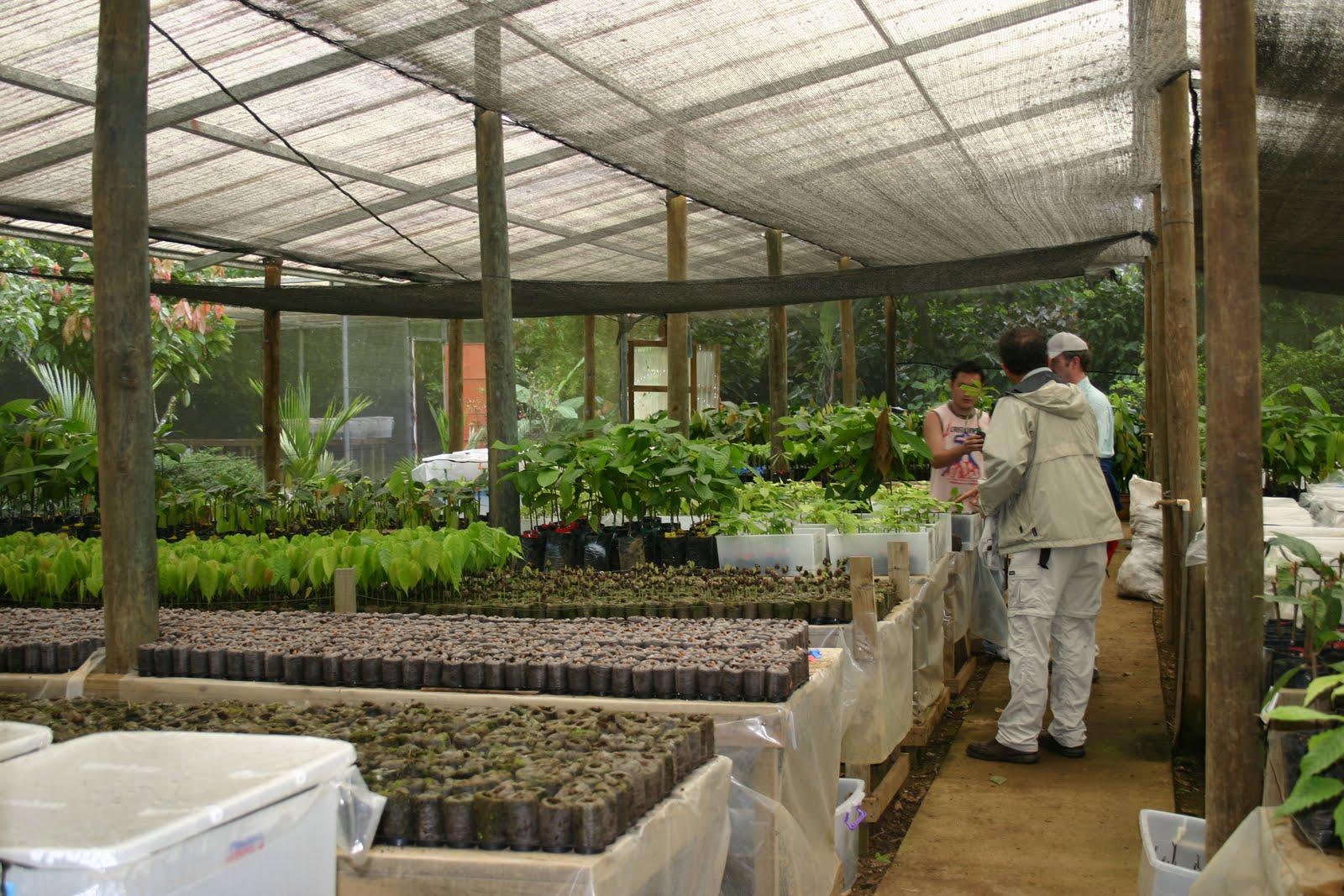
I wondered how a cacao farm that is certified organic can be surrounded by this indiscriminate dusting and still be certified. Hugh, Finmac's owner, had a brilliant solution that took into account the beauty of the jungle; plant trees that will grow very tall, very quickly around his entire farm. This forced the dust croppers to pull up very sharply when they reached the edge of Finmac's property. This sharp pulling up of the dust cropper meant the pilot had to stop dusting and, combined with a buffer of land that allows for pesticide drift, the remaining cacao trees are not affected by this spraying. While this saves Finmac's organic certification, I wonder what the long term affects this has on people and animals. I have been unable to eat a banana, and it has been nearly three months since my trip in Costa Rica.
Tuesday, June 22, 2010
A funny thing happened on the way to Finmac.
Finmac is surrounded by banana fields; fields that are owned by a large well known corporation here in the US. Two problems with banana and pineapple fields, one is the deforestation of the jungle and the other is heavy use of pesticides. The banana fields surrounding Finmac are not organic and many different types of chemicals are used to prevent a myriad of issues that bananas are prone towards. The bananas are covered, while on the tree, with large blue bags that are lined with a pesticide - this pesticide deteriorates quickly once the bag is removed - as well as crop dusting; this is done with special planes that spray the fields. As we drove down a long narrow dirt road to our destination, a plane was dusting the banana fields with pesticide(s) while at the same time, many people and animals were working in the fields or walking along the road. The crop duster was releasing pesticide while flying directly over them which included the bus we were traveling in; you could see the droplets on the windows and sides of the bus. We were shocked. When we arrived at the Finmac, we were told that this was normal practice and, while the corporation verbally does not want them to do this, it is done and there is no reprisal from the corporation.
Thursday, June 10, 2010
The second day of our class...
began with a long drive to Finmac, a cacao farm owned by Hugo Hemelink. He is dedicated to organic farming and the men and women who work for him seem to like and respect him very much.
If you look closely, near the middle of the picture above, you will see a sloth. One man showed us his scars that were on his arms from the bites of these beautiful and slow creatures.While they are slow, they are quick to protect themselves if they feel endangered.
At Finmac, we see an incredibly well managed farm, and the intense use of human labor. Like most fruits and vegetables grown in this country, it is often on the sturdy backs of men or mules that food, and here cacao, is carried. In the picture below, this man is doing the pulling of this train of beans. Because Finmac is a certified organic farm, the use of mules and their byproduct is not worth the expense or spread of disease, so it is men that harvest, clear and transport these beans to the building where the beans will be fermented, the next important process of creating chocolate flavor.
Labels:
cacao,
candy,
cocao farm,
Costa Rica,
Finmac,
organic
Wednesday, June 2, 2010
More pictures from Catie.
These pictures were also taken at Catie. Wilbert Phillips, who is head of Cacao Genetic Improvement, shows us the general process of identifying trees that are resistant to disease and still produce a bean with good flavor. We learn different ways to graft the trees, how to plant from seed, the direct impact of soil on the plant and of good management of the trees, and if that isn't a lot of information to digest, we also get an overview of the diseases that affect cacao around the world. We are shown a true criollo tree, and the frames (top picture) that house the different types of cacao for research.
If you decide to visit Costa Rica it is worth the time and effort to tour Catie's Tropical Plants Tour. Our tour guide, a lovely, vibrant young woman, was interesting and filled with loads of information of the many tropical plants.
Friday, May 28, 2010
A flowering cocoa tree...
came as a huge surprise, especially seeing the flowers, not on the end of newly grown branches but directly on the trunk of the tree. Some flowers looked like orchids, as the one in this picture, and some were little sprays of tiny flowers. So the chocolates, truffles and candies we eat, start out in an array of visual beauty and end in an array of delectable flavors. How wonderful is that?
Labels:
beans,
candies,
candy,
chocoaltes,
cocao farm,
cocoa,
flavors,
flowers,
orchids,
trees,
truffles
Monday, May 24, 2010
The itinerary said to meet in the lobby...
at 6:30am sharp. I awoke at 6:31am. In fifteen minutes, I was out the door, forgetting my map of Costa Rica and my chocolates that I brought to share with the group. The group was nearly finished with breakfast, so to finish mine, I ate at break neck speed and then we were on the bus and driving towards the Caribbean side of the country, to spend the next five days exploring Costa Rica's cocao farms.
(Please keep in mind that everything I post, is mine for my use only, and if you wish to use it, please ask me)
This picture was taken at CATIE, at the cocao development center, and one of the first cocao trees I have ever seen. Cocoa pods grow directly on the trunk or base of the tree and we saw many trees that have ripe pods, unripe pods, flowers buds and diseased pods all coexisting on the same tree. This configuration does not allow for machine harvesting, but forces the harvesting to be done by hand using long poles with a sharp knife on the end of it and the harvested pods are carried in a basket on a strong and sturdy back.
The beautiful color of these pods in this picture show they are ripe, and the color of a ripened pod depends on the type of cocao tree. Note how close these pods are to the ground. This shows careful management of the tree since when a tree is allowed to grow to its normal height, the pods that are high up in the tree are difficult to cut down, especially without damaging the tree. In the jungle, a damaged tree can quickly succumb to disease.
Monday, May 17, 2010
I arrive at the airport
in San Jose, Costa Rica, shaken but in one piece, and I am warmly greeted by our family friend Edgar V, with his daughter, AnaLara. We drive in heavy rain and wind to their beautiful home in San Ramon, where I will stay for a few days before my class starts and get a chance to adjust to the time change.
The next day we visit the town of Sarchi, and take a tour of a nearby coffee plantation. This was extremely helpful in my understanding of how Costa Rica is striving towards sustainable coffee and cocao farming practices; practices that will keep its one natural resource, the jungle, alive and well, keeping its tourist industry booming with adventure and beauty seekers coming from around the world, and thereby its economy flowing.
I was also treated to the best meal I was to have in Costa Rica. Edgar took me to his mother's home, to join his family and friends to celebratre his grandmother's 91st birthday. His mother and father once owned restaurants and the food she prepared was plentiful as it was delicious. I ate many plates of food, each filled with new and unique dishes. The food, the numerous family and friends who flowed in and out of this home left me exhausted but happy, and it gave me my first glimpse into the hospitality of the people of Costa Rica.
Wednesday, May 12, 2010
Finally...
The one thing I didn't really consider before starting this blog, is the need to have a computer with you at all times so that I could, well, write. Since my last entry, I have completed my final volunteer position as Co-Chair for Science Fair for my kids', very large, elementary school, and returned from Paris. Paris was a trip I took with a wonderful friend, to celebrate a big birthday year, that was only supposed to be seven days long. As luck would have it, volcanic ash allowed us to stay an extra seven days, perfect days, giving me plenty of time to walk, explore and taste the food and chocolate of Paris. Chocolate is very expensive for the American traveler at this time, but most shops sold small lovely tiles for a quick, wonderful private tasting on the streets of Paris. A lot of shops were closed but I will return to them on another trip, and hopefully soon.
Now, my next entry will continue talking about my chocolate class in Costa Rica. I have never eaten more chocolate in a day, everyday, as I did during that five day class. It took a lot of will power to go back to small amounts of chocolate once I returned to my normal life. If only chocolate could satisfy more of the vegetable food groups nutrients.
Subscribe to:
Posts (Atom)