Wednesday, February 23, 2011

Growing cacao tress.

Cacao's  history, so far, originates from Central and South America. Cacao trees are rather picky about where they grow.  Left to their own biological devices, it is possible that they would have grown close to their origins and not much farther, since the tree is reliant on animals to open the pods, eat and disperse the beans. At one time, it was Mexico that could boast growing the fine Criollo bean, thus having the best beans in the world.  Mexico's history is rich with stories and pictures (hieroglyphics) of the Theobroma tree and pod as the beans were used by royalty for monetary exchange and religious ceremonies, and, later in history in Europe, of the wealthy who were well aware of the physical effect on people who partook of the chocolate drink.  To that point, a side trip we made while on my Costa Rica Chocolate class, was to a small cafe called Caribeans.  Delightfully situated on the beach front, we drank hot chocolate. When cocoa beans are ground and then pressed through a commercial espresso maker, a hot drink transforms into magical brew that  is thick and creamy without milk.  I  read a description by the character E.23 in Kim, by Rudyard Kipling, who expounded on the effects of taking  small amounts of opium, as giving one heart; chocolate when consumed in this thick,creamy and concentrated form, certainly gives one heart to face the day.  The all over effect of this drink helped with my stamina needed to enjoy that day when we had the opportunity to meet  the indigenous people of Costa Rica, the Bri Bri, who introduced us to their God of the Cacao Tree.

But back on my topic. When you look at a globe, you can imagine a belt centered on the equator to understand where cacao trees grow best.  After subtracting all the water and areas that are too high in elevation or too dry or too far from water, and suddenly you have a limited area where we can get cocoa beans.  Costa Rica is able to grow the cacao tree, especially under the canopy of the jungle, giving rise, literally, to the millions of small midges that pollinate the flowers. But it isn't a perfect environment in Costa Rica for the trees, so it is always a challenge to get a high crop yield from the farmers’ efforts.

So with care, cacao trees can be planted in places that are humid, without which the seed would not thrive, year round water,  and enough shade and heat to allow quick decay of vegetation, giving rise to the tiny insects who give life to many plants and animals, and made my life a bit miserable by their sheer numbers.

Thursday, December 9, 2010

What does raw cocoa mean?

I recently was in a discussion with someone about the benefits of raw cocoa beans.  She produced a bag of nibs and asked me to taste it.  The first thing I noticed was the smell of an acidic quality signaling poor processing; the second was that the nibs were not a light white or purple but a light brown coloring. They also had a chocolate flavor, not great and they were bitter, but the chocolate flavor was there. Having eaten cacao beans straight from the pod, I knew these were not raw, and hence the confusion for people who are taken in by companies claiming to have raw beans or paste.
Raw beans are astringent.  They are very astringent. There is no chocolate flavor and the saliva is ripped out of your mouth, leaving it dry and uncomfortable.  Some people may experience this astringency more or less than myself, but it is different from the bitter quality that happens after it has been fermented.
Fermentation is a process of heat, and heat destroys pathogens and much of the antioxidants in any raw product. Fermentation also creates the chocolate flavor we recognize and enjoy.  (I remember when Odwalla used to sell unpasteurized apple juice claiming that raw was better for you. Unfortunately, a few people ended up dying from salmonella poisoning from drinking their raw apple juice.  Odwalla is lucky to still be in business, but then again, they no longer sell raw apple juice.)  Cacao beans start fermenting almost immediately after being picked off the tree, creating an environment that begins the degradation of the bacteria, pathogens and antioxidants of the raw bean. The same antioxidants that so many people believe will ward off cancer, aging and even delay death.  I won't challenge the ideas of the healing power of antioxidants,  but I will challenge the marketing of "raw beans".  Even a little heat changes a product from raw to not raw.  Parboiling before canning is a good example of eliminating those pesky bacterias that can make a person seriously ill but the parboiling process also begins killing the more fragile and desirable mineral and vitamins. Even a little fermentation of the cacao bean, under 111 degrees Fahrenheit, starts changing the beans taste and level of antioxidants available for people to benefit from when they ingest the cocoa.  I believe that unless a cacao company is putting all their pods into a refrigerated container immediately after the pod is removed from the tree and keep it under controlled cool settings all the way to the grocery shelf, that they can not, and should not, call it raw.  The expensive of doing this would make it nearly impossible for most small farmers who grow cacao trees to create this product.  I am not saying there isn't a company who is doing it with this much intergrity; I am only saying I highly doubt it and have yet to find a company who does this. 
Personally, I would enjoy chocolate in nib or candy form, for its taste and leave it to your local farmer for the fruits and vegetables that you can purchase in your city for the health benefits of antioxidants.

Monday, November 8, 2010

A signature.

Today is a perfect day to make chocolate and that is what I just finished doing, the completion of chocolate tiles, cooling and getting ready for the next step of wrapping.

As I contend with many different factors while creating these chocolate tiles, I am aware that I have a signature in my chocolate.  Painters and weavers, carpenters and architects, and all those who create for a living, have a signature.  I recently read of a newly found painting assumed to be painted by Leonardo da Vinci's very hand, without his pupils,  now under scrutiny by those who know his signature, to prove or disprove the paintings creator.  My chocolate flavor profile and the tiles themselves have my signature stamped all over them.  For the record, I make no claim of being a master painter or even a master chocolate maker.  I still have much to learn.

I make my chocolate by hand, and the imperfections tend to be repeatable.  In fact, I am not sure that I can make something completely perfect, like a machine can, and, if one day I hire someone to do some of this process of chocolate making, how that will affect my signature and is this good or bad?  I do try new methods and, even as I explore a new way of creating the tiles, I make certain style decisions that identify me as the maker.

In the end, I have product that does not last long, as does a da Vinci painting, so my signature is fleeting, but a brief moment of recognition is worth all the work I put into making chocolate.

Monday, September 13, 2010

While eating a piece of chocolate...

 Another thank you to Becky Sands for the pictures.
I contemplate the enormous amount of human effort it takes to create it .  At Catie, the process of planting the trees requires  back breaking work, a lot of common sense and attention to detail, during which the farmer must constantly attend and defend the tree and pod from the many pests, diseases, and fungus that seem to attack all cacao trees.

Then one must pick the fruits of one's labor.  The men who work at Finmac were very patient with us, giving us the opportunity to experience the skillful work of cutting off the pods, from the middle and upper parts of the tree, using the knives attached to long poles. It was tricky to cut the pod without damage to the limb, allow it to drop to the ground, and then pierce it with the small curved knife on the reverse side of the long pod cutting tool. We all  attempted to gracefully transport the pod through the air into the very large backpack and, once the backpack was full, tip all of the pods into the bucket.   
The men of Finmac  removed the good fruit (and often the bad fruit was cut down and buried later on that day) of an entire tree in the same amount of time it took us to cut down one pod; and they even dumped the pods into the buckets above .

Monday, August 30, 2010

Something to note,

the next time I travel to a country that grows cacao, I will pay attention to where the equator lies in relation to the country I am visiting, since this effects the triglycerides in the bean itself.  This is important to know since it is the fats, the triglycerides, that determine how hard the chocolate will be when tempered and gives the chocolatier a better idea of the highest and lowest heat ranges needed to create their best product.  Knowing this little piece of knowledge would have helped me tremendously as I began making chocolate with the beans I had brought back from Finmac, and saved me a lot of time and trouble and a few choice words, that are best left unwritten.  Once I did my homework and learned that Costa Rica is very close to the equator (all of three minutes), I was able to adjust my recipes and create some lovely chocolate.  Viva Costa Rica! Pura Vida Costa Rica.


(A big thank you to Becky Sands who provided me with this picture.  As always, all words. pictures and content may not be used unless you have permission from me)

Tuesday, June 29, 2010

Watching plants grow.

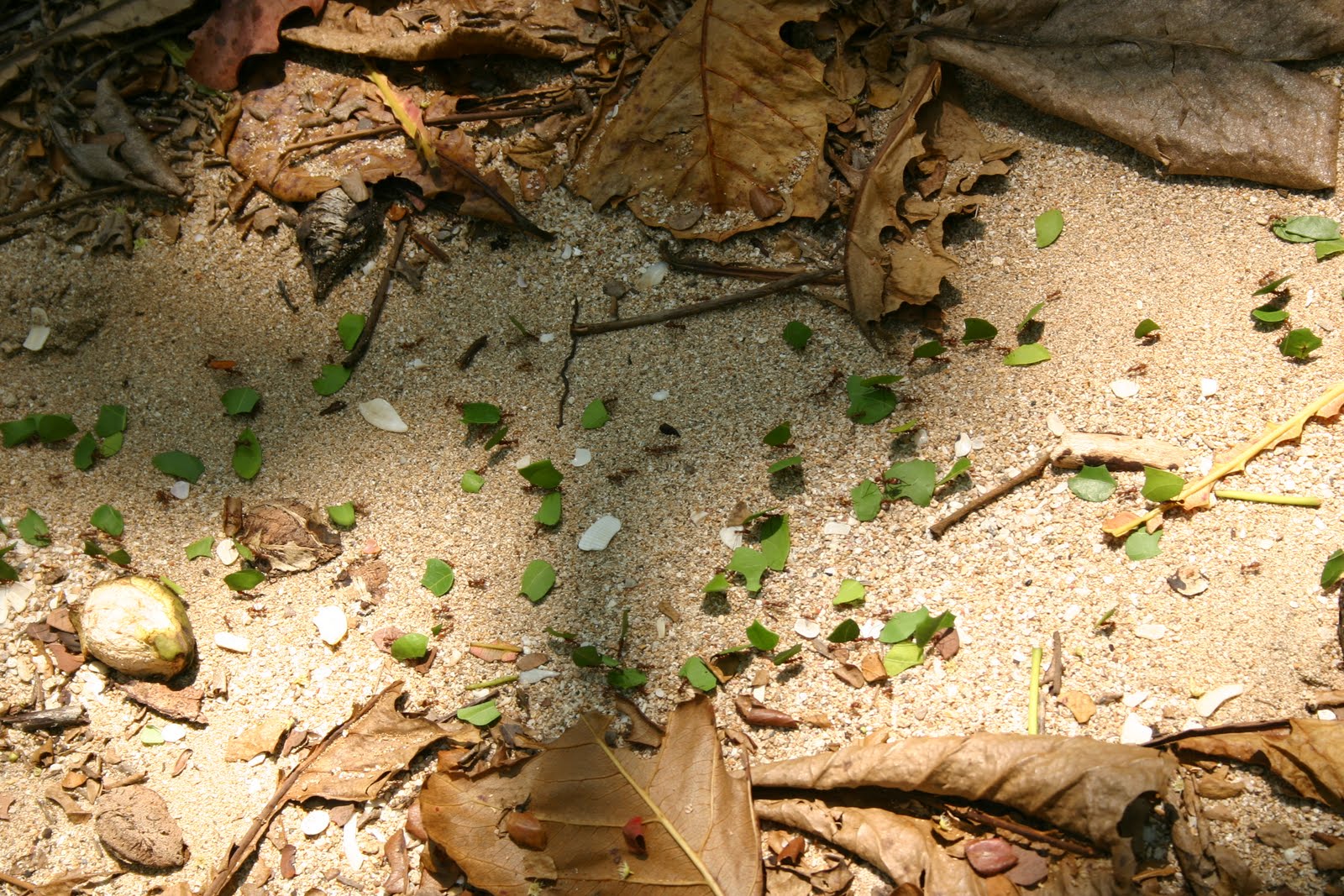
The jungle grows quickly, and the life and death cycle makes for a lot of debris on the jungle floor.  Leaf Cutter ants were abundant and you could see them carrying large pieces of leaves or flowers, some of which were removed directly from the tree and plants around us, taking them to wherever their home lay.  Where there is death, rot and decay, there is also life. An abundant amount of life. I saw more butterflies in Costa Rica than during my entire life to date, including a large blue butterfly that seemed to follow us throughout a nature walk;  chattering monkeys, one who, at first, looked as if he were smiling but, we learned, was demonstrating a sign of aggression; we noted the tourists he chased down the path, all  running at a very fast pace. The birds of prey and birds of a less aggressive nature came together in a large cloud of wings, catching the heat and circling, soaring so high that they were dots in the sky;  way too many dogs (many running in packs and clearly hungry) and bugs.  The big bugs, while scary looking, were not that difficult for me to deal with.  But it was the mosquitoes.  Deet saved the day, and the night, but there was an anxiety that I could not shake off during my entire trip of being bitten by a disease infected mosquito.  It so happened that we were in the one area of Costa Rica, the Limon region, that Dengue Fever caused a number deaths from the year before, as well as a record number of malaria infections in the same year.   
What caught me off guard was how loud the jungle is, all day and all night, reminding me of Manhattan, New York, which, like the jungle, never sleeps. This is one time I wish I had had my video camera just to tape the sound, just the sound, because the cacophony of the jungle has a musical quality that takes time to hear.

Tuesday, June 22, 2010

A funny thing happened on the way to Finmac.

Finmac is surrounded by banana fields; fields that are owned by a large well known corporation here in the US. Two problems with banana and pineapple fields, one is the deforestation of the jungle and the other is  heavy use of pesticides.  The banana fields surrounding Finmac are not organic and many different types of chemicals are used to prevent a myriad of issues that bananas are prone towards.  The bananas are covered, while on the tree, with large blue bags that are lined with a pesticide - this pesticide deteriorates quickly once the bag is removed - as well as crop dusting; this is done with special planes that spray the fields.  As we drove down a long narrow dirt road to our destination, a plane was dusting the banana fields with pesticide(s) while at the same time, many people and animals were working in the fields or walking along the road. The crop duster was releasing pesticide while flying directly over them which included the bus we were traveling in; you could see the droplets on the windows and sides of the bus.  We were shocked.  When we arrived at the Finmac, we were told that this was normal practice and, while the corporation verbally does not want them to do this, it is done and there is no reprisal from the corporation.
I wondered how a cacao farm that is certified organic can be surrounded by this indiscriminate dusting and still be certified.  Hugh, Finmac's owner, had a brilliant solution that took into account the beauty of the jungle; plant trees that will grow very tall, very quickly around his entire farm.  This forced the dust croppers to pull up very sharply when they reached the edge of Finmac's property.  This sharp pulling up of the dust cropper meant the pilot had to stop dusting and, combined with a buffer of land that allows for pesticide drift, the remaining cacao trees are not affected by this spraying. While this saves Finmac's organic certification, I wonder what the long term affects this has on people and animals.  I have been unable to eat a banana, and it has been nearly three months since my trip in Costa Rica. 


This shows the deforestation of the forest to plant pineapple plants. I am not convinced that this is necessary as the cacao and coffee farms are proving.